How Stress, Sleep, and Exercise Affect Fertility: What the Science Says


How Stress, Sleep, and Exercise Affect Fertility: What the Science Says
When you're trying to conceive, conversations about fertility tend to focus on ovulation timing, hormone levels, and medical treatments. But a growing body of research reveals that three lifestyle factors — stress, sleep, and exercise — play a surprisingly powerful role in reproductive health for both women and men. Understanding how these factors interact with your hormonal system, egg quality, sperm production, and overall fertility can help you make informed decisions as you work toward parenthood.
This comprehensive guide explores the science behind the stress-fertility connection, why sleep may be one of the most underrated fertility tools available, and how to strike the right balance with physical activity to support — rather than undermine — your reproductive goals.
How Chronic Stress Impacts Reproductive Hormones
The relationship between stress and fertility begins in the brain. When you experience stress — whether physical, emotional, or psychological — your hypothalamic-pituitary-adrenal (HPA) axis activates, triggering the release of cortisol, adrenaline, and other stress hormones. This is the classic "fight or flight" response, and in the short term, it's adaptive and protective.
But when stress becomes chronic, the persistent elevation of cortisol creates a cascade of hormonal disruptions that can directly interfere with reproduction. Here's how it works:
Cortisol suppresses GnRH: Gonadotropin-releasing hormone (GnRH) is the master signal that initiates the entire reproductive hormone cascade — triggering the release of FSH (follicle-stimulating hormone) and LH (luteinizing hormone) from the pituitary gland. Elevated cortisol has been shown to suppress GnRH pulsatility, which can delay or prevent ovulation and disrupt menstrual cycles.
HPA-HPG axis competition: The HPA axis and the hypothalamic-pituitary-gonadal (HPG) axis — which governs reproductive function — essentially compete for resources. Research published in the journal Endocrinology demonstrated that chronic stress activates pathways that inhibit the HPG axis at multiple levels, suppressing the hormonal environment needed for successful conception.
Elevated prolactin: Stress can also elevate prolactin levels. While prolactin is essential for lactation, abnormally high levels outside of breastfeeding can suppress ovulation and interfere with the luteal phase of the menstrual cycle.
Adrenal androgen production: Chronic stress stimulates adrenal glands to produce androgens (male hormones). In women, elevated androgens — such as DHEA-S — can interfere with follicle development and contribute to conditions like polycystic ovarian syndrome (PCOS), a leading cause of ovulatory infertility.
For men, chronic psychological stress is associated with reduced testosterone levels, lower sperm concentration, and decreased sperm motility. A meta-analysis covering over 57,000 men found significant associations between occupational stress and reduced semen quality parameters.
The Stress-Fertility Paradox: What Studies Actually Show
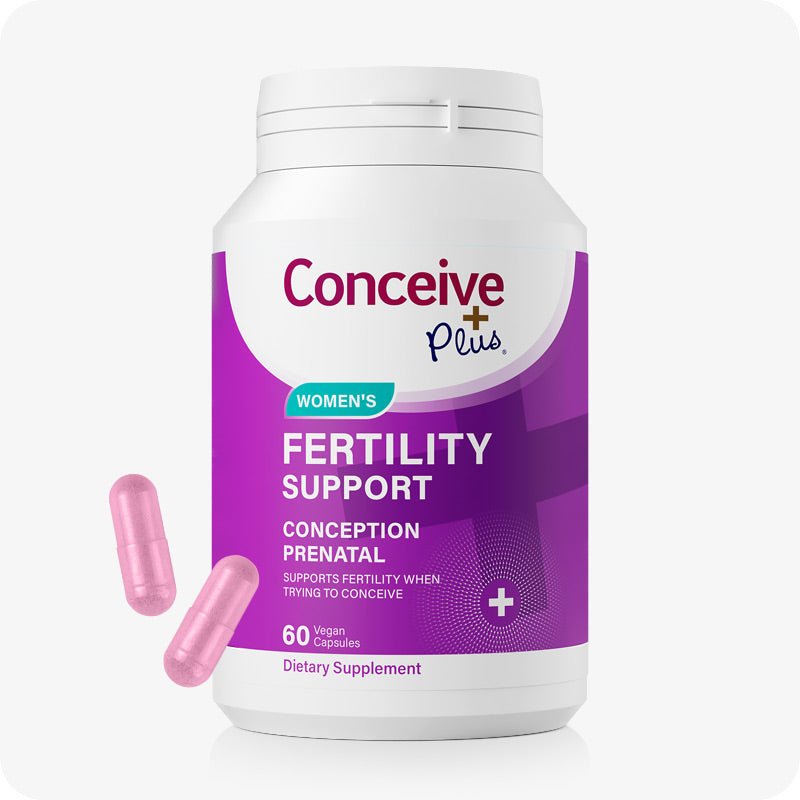
Supporting your body through every stage of your fertility journey matters. Conceive Plus Women's Fertility Support is formulated with key nutrients including Myo-Inositol, CoQ10, and folate — designed to support hormonal balance and egg quality as you work toward your goals. Explore Women's Fertility Support →
One of the most debated topics in reproductive medicine is: does stress actually cause infertility, or do infertile people experience more stress? The answer, research suggests, is likely both — and the relationship is bidirectional.
A landmark study published in Human Reproduction (2014) followed 401 American couples trying to conceive for up to 12 months. Women with higher levels of salivary alpha-amylase (a biological marker of stress) had a 29% lower probability of conception per cycle compared to women with lower levels. Importantly, cortisol levels alone did not predict the same reduction — suggesting that it may be the sympathetic nervous system activation, rather than cortisol per se, that most directly impacts fertility.
A 2019 study in Paediatric and Perinatal Epidemiology examined data from the Danish National Birth Cohort and found that women reporting high stress had a significantly longer time-to-pregnancy than their lower-stress counterparts, with an adjusted fecundability ratio of 0.91 — meaning roughly a 9% reduced likelihood of conception per cycle.
It's important to note that the evidence is not entirely one-directional. Several large prospective studies have not found stress alone to be a primary cause of infertility. Rather, stress appears to be one piece of a complex physiological puzzle. What's clear is that the stress of infertility itself is profound: studies show that women undergoing fertility treatments report levels of anxiety and depression comparable to those diagnosed with cancer or heart disease.
This creates a self-reinforcing cycle: the stress of not conceiving may further impair the body's reproductive function. Addressing stress is therefore not just about emotional wellbeing — it may be a medically meaningful intervention.
Sleep and Fertility: The Overlooked Connection
Sleep is often the first thing sacrificed when life gets busy, but for those trying to conceive, it may be the most powerful free fertility intervention available. The link between sleep and reproductive hormones is intimate and multifaceted.
Melatonin and egg quality: Melatonin — the hormone that regulates sleep-wake cycles — is also a potent antioxidant. Research has demonstrated that melatonin is concentrated in follicular fluid (the fluid surrounding developing eggs in the ovaries), where it protects oocytes from oxidative stress. Studies have found that women with lower melatonin levels have poorer egg quality and lower IVF success rates. A 2013 study in the Journal of Pineal Research showed that melatonin supplementation improved egg quality and fertilization rates in IVF patients.
Sleep deprivation and hormone disruption: Even short-term sleep deprivation significantly disrupts reproductive hormones. A study published in Current Biology found that restricting sleep to 5 hours per night for one week reduced testosterone levels in young healthy men by 10-15%. For women, disrupted sleep alters the pulsatile secretion of LH, which is essential for triggering ovulation.
Circadian rhythm and FSH: The body's internal clock (circadian rhythm) governs the timing of many hormone pulses. FSH is released in a circadian pattern, and disruptions to that rhythm — such as those caused by shift work, irregular sleep schedules, or chronic insomnia — can impair follicular development.
Shift work and fertility: A review of 12 studies found that women who work night shifts have a 33% higher risk of menstrual irregularity and a significantly higher risk of subfertility compared to day workers. Male shift workers also show reduced sperm quality, with studies noting lower sperm concentration and motility in men working irregular hours.
Sleep and BMI regulation: Chronic sleep deprivation is strongly linked to obesity — itself a significant risk factor for reduced fertility in both men and women — through its effects on leptin and ghrelin (appetite-regulating hormones). Poor sleep increases ghrelin (hunger) and reduces leptin (satiety), creating hormonal conditions that promote weight gain and further hormonal imbalance.
How Much Sleep Do You Really Need When Trying to Conceive?
The National Sleep Foundation and the American Academy of Sleep Medicine both recommend 7–9 hours of sleep per night for adults aged 18–64. But when trying to conceive, there's emerging evidence that both too little and too much sleep may be suboptimal.
A large prospective cohort study published in Fertility and Sterility examined sleep duration and IVF outcomes in 656 women. Women sleeping 7–8 hours per night had the highest live birth rates (53%), while those sleeping fewer than 6 hours or more than 9 hours had significantly lower rates. The researchers hypothesized that both extremes may reflect underlying physiological dysregulation.
For men, similar data exists. A study of 981 Danish men found that those with consistent, good sleep quality had significantly higher sperm concentration and total sperm count compared to men with poor sleep. Sleep disturbances — including difficulty falling asleep, waking during the night, and excessive daytime sleepiness — were each independently associated with reduced semen quality.
Practical sleep targets when TTC:
- Aim for 7–8 hours of quality, uninterrupted sleep nightly
- Keep consistent sleep and wake times, including weekends
- Create a dark, cool sleep environment to support melatonin production
- Avoid screens (blue light suppresses melatonin) for 60–90 minutes before bed
- Limit caffeine after 2 pm, as its half-life of approximately 5–6 hours can impair sleep architecture
Exercise and Fertility: Finding the Sweet Spot
Exercise is widely recognized as beneficial for health — but when it comes to fertility, the relationship is more nuanced than "more is better." The key is finding the sweet spot between too little and too much.
The benefits of moderate exercise: Regular moderate-intensity exercise improves insulin sensitivity, reduces systemic inflammation, supports a healthy body weight, and modulates stress hormones — all of which benefit fertility. A prospective cohort study involving over 17,000 women in the Nurses' Health Study II found that vigorous exercise was associated with a reduced risk of ovulatory infertility, particularly among overweight and obese women.
For men, moderate exercise is clearly beneficial. A 2017 meta-analysis in the British Journal of Sports Medicine found that moderate regular exercise was associated with significantly higher sperm concentration, motility, and total motile sperm count compared to sedentary men. Physical activity also appears to reduce oxidative stress in seminal plasma, which can damage sperm DNA.
The risks of excessive exercise: At the other end of the spectrum, excessive exercise — particularly in combination with caloric restriction — can suppress the reproductive axis in a condition known as "functional hypothalamic amenorrhea" (FHA) or, more broadly, the "female athlete triad" (now called Relative Energy Deficiency in Sport, or RED-S).
FHA occurs when the energy demands of training outstrip caloric intake, leading to a reduction in GnRH pulsatility, suppression of LH and FSH, and ultimately anovulation (loss of ovulation). Studies estimate that up to 40–60% of elite female athletes experience menstrual irregularities, ranging from subtle luteal phase defects to complete amenorrhea. Even recreational runners can be affected if their caloric deficit is significant enough.
For men, excessive endurance exercise — particularly long-distance cycling — has been associated with reduced sperm count and motility, potentially due to scrotal heat from prolonged cycling and oxidative stress from intense training.
Exercise guidelines when TTC:
- Aim for 150 minutes of moderate-intensity aerobic exercise per week (walking, swimming, cycling at a comfortable pace)
- Include 2–3 sessions of strength training for insulin sensitivity and hormonal health
- Avoid high-intensity training exceeding 60 minutes per session if you have irregular cycles
- Ensure caloric intake matches energy expenditure — under-eating is a significant fertility risk
- If you're a competitive athlete with irregular periods, speak with a reproductive endocrinologist about energy availability assessment
Practical Strategies to Reduce Stress While TTC
Knowing that stress affects fertility is useful; knowing what to do about it is essential. Here are evidence-based approaches for managing stress during the conception journey:
Mindfulness-based stress reduction (MBSR): A randomized controlled trial published in Fertility and Sterility found that women who participated in a 10-week mind-body program had significantly higher pregnancy rates (55%) compared to a control group (20%). MBSR teaches breath awareness, body scanning, and non-reactive observation of thoughts — skills that directly reduce cortisol and sympathetic nervous system activation.
Cognitive behavioral therapy (CBT): CBT for infertility-related distress has demonstrated effectiveness in multiple clinical trials. It helps patients identify and reframe catastrophic thinking patterns — a common feature of the fertility journey — and develop practical coping strategies.
Acupuncture: While evidence remains mixed, several systematic reviews suggest acupuncture may reduce psychological stress and potentially improve IVF outcomes. A 2019 Cochrane review noted that acupuncture was associated with some improvements in clinical pregnancy rates in certain populations, though more research is needed.
Social support: Research consistently shows that strong social support buffers against the psychological impact of infertility. Couples who join support groups or connect with others going through similar experiences report significantly lower levels of anxiety and depression. Fertility-specific online communities, therapist-led support groups, and peer counseling programs are all validated options.
Limiting fertility-related media consumption: Paradoxically, obsessively researching fertility online can amplify anxiety. Setting intentional limits on time spent reading about fertility — particularly social media — can significantly reduce cyclical anxiety patterns.
Progressive muscle relaxation and diaphragmatic breathing: Simple, evidence-based techniques that activate the parasympathetic nervous system ("rest and digest"), lowering heart rate, blood pressure, and cortisol. Just 10–15 minutes daily can produce measurable physiological effects within weeks.
Integrating Lifestyle Changes Into Your Fertility Plan
The most effective approach to fertility lifestyle changes is integrative — addressing stress, sleep, and exercise together as interconnected systems rather than isolated variables. Here's how to create a holistic plan:
Start with sleep as the foundation. Sleep deprivation exacerbates both stress reactivity and motivation to exercise. Fixing sleep first often makes the other two changes easier. Begin by establishing a consistent sleep-wake schedule for two to three weeks before adding other changes.
Use exercise as a stress management tool. Rather than thinking of exercise purely as a physical health intervention, reframe it as your primary stress regulation strategy. A 30-minute walk outdoors reduces cortisol, boosts endorphins, and improves sleep quality. This reframe makes it easier to prioritize movement without the pressure of intense training schedules.
Track your cycle alongside lifestyle metrics. Apps like Natural Cycles, Clue, or Ovia allow you to log sleep, exercise, and stress alongside cycle data. Over several months, you may identify personal patterns — for example, that poor sleep in the follicular phase correlates with longer cycles, or that high-stress weeks delay ovulation.
Communicate openly with your partner. The fertility journey affects both partners, and research shows that couples who communicate openly about stress, expectations, and emotional needs experience significantly lower rates of anxiety and higher relationship satisfaction — which itself is associated with better outcomes.
Work with a healthcare provider. If stress is causing menstrual irregularity, a gynecologist or reproductive endocrinologist can evaluate whether functional hypothalamic amenorrhea, thyroid dysfunction, or other hormone imbalances are contributing. If sleep disturbance is severe, a sleep specialist can assess for insomnia disorder or sleep apnea (a condition increasingly linked to reduced fertility in both sexes).
Fertility is a complex process influenced by dozens of biological, environmental, and psychological variables. While medical intervention is sometimes necessary, the evidence is clear that optimizing stress, sleep, and exercise creates a meaningful, measurable hormonal environment that supports natural conception and improves outcomes for those undergoing fertility treatment.
Frequently Asked Questions
Can stress alone cause infertility?
Stress is unlikely to be the sole cause of infertility in most cases, but chronic psychological stress can disrupt the hormonal cascade needed for ovulation and sperm production. Research shows associations between high stress markers and reduced monthly conception probability of up to 29%. Addressing stress is a meaningful part of a comprehensive fertility plan.
How quickly does stress affect fertility?
The effects of stress on reproductive hormones can occur within hours of a stressor (as cortisol rapidly suppresses GnRH), but chronic effects — such as menstrual cycle disruption — typically develop over weeks to months of sustained stress. Recovery also occurs over a similar timeframe when stressors are resolved.
Is it normal for my period to become irregular when I'm stressed?
Yes. Stress-induced suppression of GnRH can delay or prevent ovulation, leading to longer, shorter, or missed cycles. This is one of the clearest demonstrations of the mind-body connection in reproductive health. If irregular cycles persist for more than two to three months, consult a healthcare provider to rule out other causes.
Does exercise improve fertility?
Moderate regular exercise improves insulin sensitivity, reduces inflammation, supports a healthy BMI, and reduces stress — all of which benefit fertility. However, excessive exercise combined with caloric restriction can suppress ovulation in women and reduce sperm quality in men. Aim for 150 minutes of moderate activity weekly.
Can over-exercising cause infertility?
Yes. Excessive training combined with insufficient caloric intake can lead to functional hypothalamic amenorrhea (FHA) — a condition in which ovulation ceases due to reproductive axis suppression. Studies estimate that 40–60% of elite female athletes experience menstrual irregularities. Reducing training intensity and increasing caloric intake typically restores ovulation within 3–6 months.
How does sleep deprivation affect fertility?
Sleep deprivation disrupts melatonin production (which protects egg quality), suppresses testosterone in men (by up to 15% with just one week of restricted sleep), and alters the pulsatile secretion of LH — which triggers ovulation. Consistently poor sleep is also linked to obesity, insulin resistance, and elevated cortisol — all of which further impair fertility.
What is the ideal amount of sleep when trying to conceive?
Research suggests 7–8 hours of quality, uninterrupted sleep nightly is optimal for fertility. Both under-sleeping (fewer than 6 hours) and over-sleeping (more than 9 hours) have been associated with reduced IVF success rates in clinical studies. Consistent sleep and wake times — even on weekends — are equally important.
Does yoga help fertility?
Yoga combines moderate physical movement with mindfulness and breathwork — all three of which have independent evidence for stress reduction. While direct evidence linking yoga specifically to improved fertility outcomes is limited, its components (stress reduction, improved sleep, gentle exercise) are individually supported by research. Many fertility clinics include yoga as part of their complementary care programs.
Can my partner's stress affect our chances of conceiving?
Yes. Chronic stress in men is associated with reduced testosterone, lower sperm concentration, and decreased sperm motility. A meta-analysis of over 57,000 men found significant associations between work stress and reduced semen quality. Supporting your partner's stress management is therefore a shared fertility strategy.
Should I stop exercising completely during my two-week wait?
There is no medical evidence that moderate exercise should be stopped during the two-week wait (2WW) in natural conception cycles. Gentle to moderate exercise (walking, yoga, swimming) is generally considered safe and may even reduce the anxiety characteristic of the 2WW. High-intensity or very strenuous exercise is sometimes cautiously reduced, particularly during IVF cycles, based on clinical guidance from your reproductive specialist.
Supporting your body through every stage of your fertility journey matters. Conceive Plus Women's Fertility Support is formulated with key nutrients including Myo-Inositol, CoQ10, and folate — designed to support hormonal balance and egg quality as you work toward your goals. Explore Women's Fertility Support →