Male Fertility Test at Home: What Your Results Mean and What to Do Next


Male Fertility Test at Home: What Your Results Mean and What to Do Next
If you've been trying to conceive without success, understanding male fertility test at home options can be one of the most empowering steps a couple takes. Male factor infertility accounts for approximately 40–50% of all infertility cases, yet male testing is often the last thing couples consider. Modern at-home sperm tests are changing that — giving men private, affordable access to key data about their reproductive health. In this comprehensive guide, we break down everything you need to know about at-home male fertility testing, what results mean, and what you can do if the numbers aren't where you want them.
Why Male Fertility Testing Matters More Than Most Men Think
The male fertility test at home conversation often gets overshadowed by the focus placed on female fertility. But the data is clear: in roughly one-third of infertility cases, the primary issue is male-related. In another 20% of cases, both partners have contributing factors. That means in up to 50% of couples struggling to conceive, sperm quality plays a central role.
Yet historically, male fertility testing required a visit to a urologist or fertility clinic, often after months of trying. Today, home sperm tests provide a quick, discreet first screen — giving couples actionable information far earlier in the process.
Key metrics that at-home male fertility tests typically measure include:
- Sperm count (concentration): The number of sperm per millilitre of semen
- Motility: The percentage of sperm that are moving
- Morphology: The shape and structure of sperm (some tests)
- Total motile sperm count: A combined score of concentration × volume × motility
The World Health Organization (WHO) defines normal semen parameters: concentration ≥16 million/mL, total motility ≥42%, progressive motility ≥30%, and normal morphology ≥4%.
✨ Support Your Fertility Journey with Conceive Plus
Clinically formulated supplements to support sperm health and female fertility. Shop Now →
Types of Male Fertility Tests Available at Home
A male fertility test at home comes in several formats, each with different capabilities:
Basic Count-Only Tests
These use a colour-change strip or simple device to estimate whether sperm count is above or below a threshold (typically 20 million/mL). They give a pass/fail result rather than precise data. Examples include older OTC test kits found in pharmacies.
Smartphone-Connected Sperm Analysers
More advanced options use a microscope attachment or dedicated device that connects to your smartphone. These provide quantitative results for motility, concentration, and sometimes morphology. Brands like YO, Trak, and ExSeed fall into this category with results comparable to basic clinic analysis.
Lab-Processed Mail-In Tests
You collect a sample at home and mail it to a certified lab. These provide the most comprehensive analysis — including count, motility, morphology, volume, and pH — with results delivered online. Companies like Legacy and Fellow offer this service with clinical-grade accuracy.
How to Get Accurate Results: Pre-Test Guidelines
The accuracy of your home sperm test depends significantly on how you prepare. Follow these guidelines for the most reliable results from your male fertility test at home:
- Abstain for 2–5 days: Sexual abstinence of 2–5 days before collection optimises both volume and concentration
- Avoid alcohol and hot baths: Heat exposure and substance use in the 72 hours before testing can temporarily impair sperm quality
- Avoid standard lubricants: Common lubricants can affect sperm motility in the sample. If needed, use a sperm-safe product like Conceive Plus
- Test at the right time of day: Some studies suggest sperm concentration is slightly higher in morning samples
- Follow kit instructions precisely: Contamination or temperature errors can skew results
Interpreting Your Results: What the Numbers Mean
Once you have your at-home sperm test results, here's how to interpret them against WHO 2021 reference values:
- Semen volume: Normal ≥1.4 mL | Optimal 2–5 mL
- Sperm concentration: Normal ≥16 million/mL | Optimal 40+ million/mL
- Total sperm count: Normal ≥39 million | Optimal 80–150 million
- Total motility: Normal ≥42% | Optimal 55%+
- Progressive motility: Normal ≥30% | Optimal 45%+
- Normal morphology: Normal ≥4% | Optimal 10%+
Low Count (Oligospermia)
A sperm concentration below 16 million/mL is classified as oligospermia. Severe oligospermia is below 5 million/mL. Low count can result from hormonal imbalances, varicocele, infections, or lifestyle factors. Importantly, lifestyle interventions and targeted supplementation can meaningfully improve count over 2–3 months.
Low Motility (Asthenospermia)
When fewer than 42% of sperm are moving, or fewer than 30% show progressive forward movement, this is called asthenospermia. Poor motility is one of the most common male fertility findings and responds particularly well to antioxidant supplementation. Nutrients like CoQ10, L-carnitine, zinc, and selenium have clinical evidence supporting motility improvement.
Abnormal Morphology (Teratospermia)
Morphology refers to the shape of sperm. If fewer than 4% of sperm have normal morphology, this is classified as teratospermia. Antioxidant supplementation has shown modest improvements in clinical trials. The key is consistency over at least 90 days.
Conceive Plus vs Pre-Seed: Which Lubricant is Best for TTC?
When trying to conceive, lubricant choice matters enormously. Many men don't realise that standard lubricants — including popular brands like KY Jelly, Astroglide, and even saliva — can significantly impair sperm motility. Research published in Fertility and Sterility found that common lubricants reduced sperm motility by 60–100% within 30 minutes of exposure.
Both Conceive Plus and Pre-Seed are marketed as sperm-friendly lubricants, but there are important differences. Conceive Plus is formulated with calcium and magnesium ions, which actively support capacitation — the final maturation step sperm undergo before fertilising an egg. It matches the natural pH and osmolality of fertile cervical mucus (pH 7–8, osmolality 280–380 mOsm/kg). Conceive Plus is FDA-cleared as a fertility lubricant and widely used in fertility clinics across the United States and Europe.
Pre-Seed was one of the first sperm-safe lubricants on the market and remains a solid option, but it lacks the added ionic formula of Conceive Plus. For couples where male fertility is a concern — particularly motility or count — Conceive Plus's ion-enriched formula provides an additional supportive layer that Pre-Seed cannot match.
The 90-Day Plan: Improving Sperm Health After Testing
Given the 74-day sperm production cycle, a 90-day targeted intervention is the minimum meaningful window for re-testing. The spermatogenesis cycle means that changes you make today won't appear in your sperm analysis for about 2–3 months. Starting a proven supplement protocol immediately gives your next male fertility test at home the best chance of showing improvement.
Key nutrients with the strongest evidence for male fertility include:
- CoQ10 (200–600mg/day): Improves sperm motility and count in multiple RCTs
- L-carnitine (1–3g/day): Supports sperm energy metabolism and motility
- Zinc (25–40mg/day): Critical for testosterone production and sperm formation
- Selenium (100–200mcg/day): Protects sperm from oxidative damage
- Folate/5-MTHF (400–800mcg/day): Reduces sperm DNA fragmentation
- Vitamin D3: Low vitamin D is associated with lower sperm motility
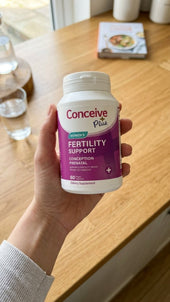
Conceive Plus offers a clinically formulated male fertility supplement containing all key nutrients in therapeutic doses — including CoQ10, L-carnitine, zinc, selenium, and vitamin D3. This is the convenient, evidence-backed option for men who want to optimise sperm health while awaiting clinical evaluation or re-testing.
When to Move From Home Testing to a Fertility Clinic
A male fertility test at home is an excellent starting point, but it has limitations. Here's when to escalate to professional care:
- Two consecutive at-home tests showing abnormal results
- Sperm count below 5 million/mL (severe oligospermia)
- Zero sperm detected (azoospermia)
- Partner has also had fertility evaluation that is normal
- You've been trying to conceive for 12 months (or 6 months if partner is 35+)
- History of testicular surgery, infection, or injury
A reproductive urologist can offer interventions ranging from lifestyle coaching and supplements, to varicocele repair (which can improve sperm count by 50–70% in appropriate candidates), to hormonal treatment, to assisted reproductive technologies (IUI, IVF with ICSI) for severe cases.
Frequently Asked Questions: Male Fertility Test at Home
How accurate are at-home male fertility tests?
Basic count-only tests have an accuracy of around 85–90% for detecting count above or below threshold. Smartphone-connected devices that measure motility achieve accuracy closer to clinical analysis when used correctly. Mail-in lab tests are the most accurate, often matching clinic results within 10–15%.
Can a home sperm test detect azoospermia (no sperm)?
Some tests can detect very low or absent sperm, but a negative result at home should always be confirmed by clinical analysis. Azoospermia requires further investigation to determine whether it is obstructive or non-obstructive.
How often should I test my sperm at home?
If results are abnormal, re-test after 90 days on a supplement and lifestyle protocol. If you are simply monitoring, a quarterly test provides useful trend data.
Can stress affect my home sperm test results?
Yes. Psychological stress elevates cortisol, which can suppress testosterone and temporarily impair sperm production. Try to test during a period of low stress for the most representative results.
Can supplements actually improve sperm count and motility?
Yes. Multiple randomised controlled trials show that nutrients including CoQ10, L-carnitine, zinc, selenium, and folate improve sperm parameters, particularly motility and count, over 3–6 months. The effect size varies by individual and baseline deficiency levels.
How long does sperm production take?
The full spermatogenesis cycle takes approximately 74 days. This is why interventions — whether supplements, lifestyle changes, or treatment — take at least 3 months to show results in a sperm test.
Should both partners test at the same time?
Yes. Testing both partners simultaneously is the most time-efficient approach. It prevents the common situation of spending months focused on female fertility investigation before testing the male partner.
What is the most important supplement for sperm health?
CoQ10 has the broadest clinical evidence base for improving sperm motility and count. However, a comprehensive formula addressing multiple nutrients — zinc, selenium, folate, L-carnitine, and CoQ10 — will be more effective than any single nutrient alone.
Are at-home male fertility tests covered by insurance?
Most at-home sperm tests are not covered by insurance, though costs range from $20 for basic tests to $150 for comprehensive mail-in analysis. Some FSA/HSA accounts may cover the expense.
Can I use a lubricant during the sample collection?
Standard lubricants can affect sperm motility in the sample. For intercourse timing during the fertile window, always use a fertility-safe lubricant like Conceive Plus to protect sperm from lubricant-induced damage.
Ready to Support Your Sperm Health?
Conceive Plus men's fertility supplements are formulated with CoQ10, L-carnitine, zinc, selenium, and folate — the nutrients your sperm need most. Start your 90-day protocol today.
Shop Conceive Plus Now →