When to Take an Ovulation Test: A Step-by-Step Timing Guide for 2026


Most people think tracking fertility is as simple as counting to fourteen, but starting your tests on the wrong day is the fastest way to waste expensive kits. Knowing exactly when to take an ovulation test requires more than just a calendar; it requires syncing your testing schedule with the specific biological rhythm of your luteinizing hormone (LH). If you've been guessing your start date, you're likely missing the very window that matters most.
It's completely normal to feel anxious about missing that short LH surge or confused about when your cycle actually begins. You've likely felt the frustration of staring at a blank test strip and wondering if you started too early or if your peak already passed you by. This confusion is common, especially since the global market for these kits is reaching over 536 million dollars in 2026 as more people search for clarity.
We're here to help you master your fertile window with an expert guide on the exact day and hour to begin testing. You'll learn why the 10 a.m. to 8 p.m. window is the gold standard for accuracy, how to navigate tracking with the newly renamed polyendocrine metabolic ovarian syndrome (PMOS), and how to use the latest digital tools to confirm ovulation is actually happening.
Key Takeaways
- Learn how to accurately calculate your testing start date by identifying your true Day 1 and tracking your average cycle length.
- Discover exactly when to take an ovulation test during the day to avoid false negatives, focusing on the 10 a.m. to 8 p.m. window rather than first morning urine.
- Master the science of the LH surge to distinguish between your overall fertile window and the critical 24-hour life of the egg.
- Gain specialized strategies for tracking ovulation with irregular cycles or PCOS, including the "shortest cycle" rule to ensure you never miss your peak.
- Understand the 48-hour countdown after a positive result and how to optimize your environment for successful conception.
Understanding the LH Surge: Why Timing Matters
To master your fertility, you have to understand the biological master switch known as Luteinizing Hormone (LH). This hormone is produced by your pituitary gland and stays at low levels throughout most of your cycle. However, about midway through, your body triggers a massive, sudden spike in LH. This surge is the specific signal that tells your ovary to release a mature egg. Without this hormonal peak, ovulation won't occur, which is why identifying the surge is the most critical step in conception.
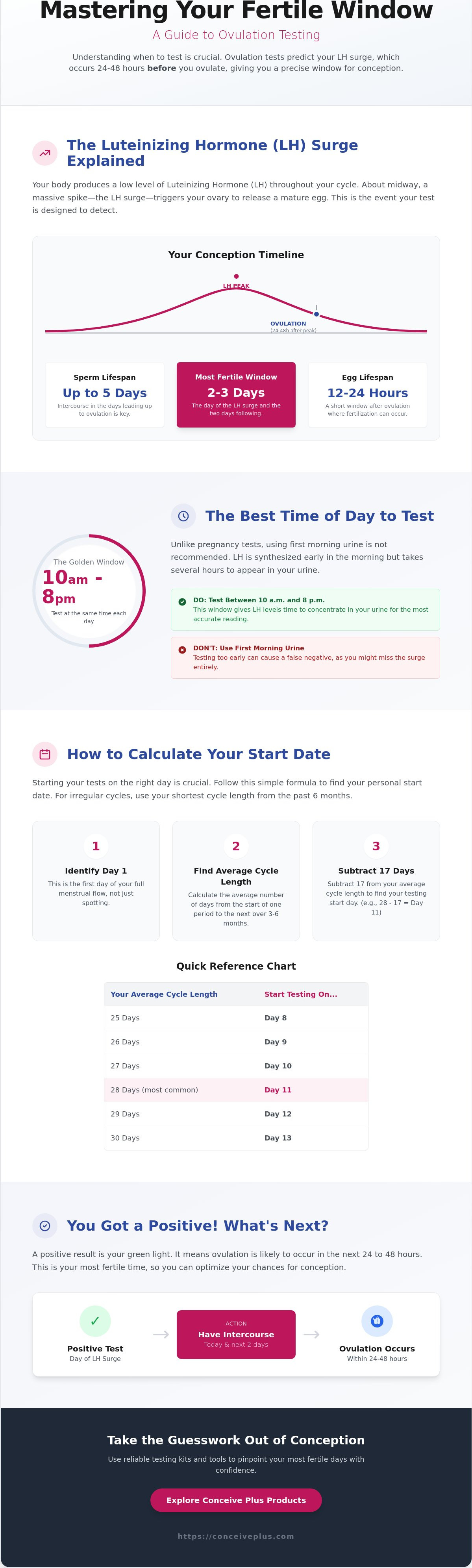
Many people mistake an ovulation test for a tool that tells them they are ovulating right this second. In reality, these tests are predictive, not confirmatory. They detect the LH surge that happens 24 to 48 hours before the egg is actually released. Because an egg only lives for 12 to 24 hours after leaving the ovary, you need to know when to take an ovulation test to ensure sperm are already present and waiting. Since healthy sperm can survive for up to five days inside the reproductive tract, your intercourse strategy should focus on the days leading up to the surge, not just the day of.
To better understand this concept, watch this helpful video:
The 24-48 Hour LH Window
The window between your LH surge and the actual release of the egg is your most fertile period. If you start testing too late in your cycle, you'll likely see a negative result because the surge has already passed. A positive test result is your "green light" for intercourse. You should prioritize baby-making on the day you see that positive line and for the following two days. This ensures you cover the entire window from the surge through the end of the egg's short lifespan.
Hormonal Triggers vs. Physical Signs
While physical signs like "egg white" cervical mucus or mild pelvic twinges are helpful, they aren't as reliable as hormonal data. LH tests offer a concrete answer that calendar-based tracking often misses, especially if your cycle fluctuates by a few days. Modern tests often distinguish between "high" fertility (rising estrogen) and "peak" fertility (the LH surge). Using an ovulation calculator can help you narrow down your starting dates, but the test strips provide the real-time proof your body is ready. Combining these tools gives you the highest level of precision for 2026.
How to Calculate Your Start Date for Testing
Calculating exactly when to take an ovulation test doesn't have to be a guessing game. The process begins with one vital anchor: Day 1. You must identify Day 1 as the first day of your full menstrual flow. Spotting or light brown discharge doesn't count. If your period starts late at night, many experts suggest marking the next morning as Day 1 to ensure your timeline remains accurate.
Once you've identified your start date, you need to determine your average cycle length. Don't just rely on last month's data. Look back at your records from the last three to six months to find the average number of days from the start of one period to the start of the next. This historical data is essential because your body's LH surge typically happens about 14 days before your next period begins.
To find your testing window, use the "Cycle Day Minus 17" rule. Subtract 17 from your average cycle length. For a standard 28-day cycle, this means you'll start testing on Day 11. This calculation is the most reliable way to figure out when to take an ovulation test for your specific body. According to the FDA guide to ovulation tests, these kits are highly sensitive, but they only work if you're testing during the window when LH is actually rising. If you'd rather skip the manual math, using an online ovulation calculator can provide instant precision.
The Standard 28-Day Cycle Plan
Starting on Day 10 or 11 is the ideal strategy for most women with a 28-day cycle. This early start allows you to establish a baseline LH level, making it easier to see when the test line begins to darken. If your cycle is shorter, such as 21 days, you'll need to start as early as Day 4. Conversely, if you have a 35-day cycle, your first test shouldn't happen until Day 18. Adjusting your start date prevents you from wasting expensive strips during days when ovulation is biologically impossible. Once you have your dates, you can find support for your journey at Conceive Plus.
Tracking and Record Keeping
Consistency is your best friend when tracking fertility. Logging every result in a fertility tracking tool helps you recognize patterns that aren't obvious on a single strip. Don't stop testing the moment you see a faint second line. LH is always present in your system; you're looking for the "peak" where the test line is as dark as or darker than the control line. Over several months, you'll begin to see your personal LH rhythm, which reduces anxiety and saves money on future kits.
The Best Time of Day to Take an Ovulation Test
If you've ever taken a pregnancy test, you know that "first morning urine" is the gold standard. However, applying that same logic to when to take an ovulation test is a common mistake that can lead to missed surges. While pregnancy tests look for hCG, which builds up while you sleep, LH is different. Your body typically produces LH in the early morning hours, and it takes several hours for that hormone to filter through your kidneys and reach your bladder. Testing too early in the day often results in a false negative simply because the hormone hasn't arrived in your urine yet.
Testing between 10:00 AM and 8:00 PM is widely considered the "Golden Window" for peak LH detection. Most women see their highest concentrations in the early afternoon. If you're using best-selling fertility products to track your cycle, you'll find that testing during this specific timeframe provides the clearest, most reliable results. For the highest level of accuracy, you should also follow the "Two-Hour Hold" rule. This means limiting your fluid intake and avoiding the bathroom for at least two hours before testing. Excessive water consumption can dilute your urine, making a surge appear much weaker than it actually is.
Why Second Morning Urine Wins
LH is synthesized in your blood in the morning and requires time to manifest in your waste. There is typically a 4-hour delay between the time LH surges in your bloodstream and when it becomes detectable in your urine. This is why "second morning urine"—the sample you provide after your first bathroom trip of the day—is far more effective for those who want to know when to take an ovulation test for the best results. If you work night shifts or have irregular sleep patterns, aim to test about four to five hours after you wake up to ensure your body has had enough time to process the hormone.
Consistency is Key
Establishing a routine is vital because LH surges can be incredibly short. Some women experience a "rapid surge" that lasts only a few hours, meaning a test taken at 10:00 AM might be negative while one at 4:00 PM is blazing positive. Understanding how to use ovulation kits correctly involves testing at the same time every day to create a reliable data set. If you suspect you have a short surge, consider testing twice daily, once in the morning and once in the evening. Remember that a faint line is not a positive result; the test line must be as dark as or darker than the control line to confirm your peak fertility.
Testing with Irregular Cycles or PCOS
Standard advice often assumes every woman has a textbook 28-day cycle. For those with irregular periods, figuring out when to take an ovulation test feels like shooting at a moving target. If your cycle varies significantly, the most reliable approach is the "Shortest Cycle" rule. Look at your history from the last six months and identify your shortest cycle length. Subtract 17 from that number to find your starting day. This method ensures you begin testing early enough to catch an unexpected early surge, even if your cycle usually runs long most of the time.
Tracking becomes more complex for those with Polycystic Ovary Syndrome, which a global consensus panel renamed polyendocrine metabolic ovarian syndrome (PMOS) in May 2026. This condition often causes high baseline levels of LH, which can lead to "false surges" or multiple peaks. You might see a dark line that fades and then returns a week later. Because of this, you'll likely need more test strips per cycle than the average user. If you consistently see positive results for more than three days or never see a clear peak despite diligent tracking, it's time to consult a fertility specialist.
The Long-Cycle Strategy
When your cycle extends beyond 35 days, testing every day for weeks is expensive and exhausting. To manage costs, wait until you notice secondary fertility signs, like changes in cervical mucus, before you start using your kits. Many women find success by using affordable fertility product bundles that include bulk strips. Combining LH tests with Basal Body Temperature (BBT) tracking provides a secondary layer of confirmation. While the LH test predicts ovulation, a BBT rise confirms that the egg was actually released, giving you a complete picture of your hormonal health.
Managing Expectations and Stress
The "did I miss it?" anxiety is real when your strips stay faint day after day. Remember that a negative test in a single month doesn't always mean you didn't ovulate; it might just mean the surge was too brief to catch. Stress itself can delay ovulation, creating a frustrating cycle of late periods and late testing. Reading through Conceive Plus reviews can offer perspective, as many others have shared their success stories while managing irregular cycles. If you're looking for more ways to support your journey, you can explore fertility support options to help optimize your path to conception.
The Positive Result: What to Do Next
Seeing two dark lines on your test strip is the moment everything changes. You've successfully navigated the technical challenge of when to take an ovulation test, and now the biological countdown begins. A positive result indicates that your LH surge is peaking, giving you a 0 to 48-hour window where conception is most likely. This is your "green light" period. While timing is the foundation of success, the environment you create during these hours is what determines if the sperm can actually reach the egg.
Many couples make the mistake of using standard over-the-counter lubricants during this critical window. Most traditional lubes are formulated with a low pH and high salt levels to match the typical vaginal environment, but these conditions are toxic to sperm. They act as a chemical barrier that can stall or even kill the very cells you're trying to track. To support your journey, it's vital to switch to a fertility friendly lubricant that won't hinder motility.
Optimizing the Fertile Window
Once the surge is detected, intercourse frequency becomes a common question. Most experts recommend having sex daily or at least every other day for the next 48 hours. This ensures a consistent supply of healthy sperm is waiting in the fallopian tubes when the egg is released. The science of sperm friendly lubricant for fertility shows that maintaining a specific pH balance is essential. Sperm are extremely sensitive; they require an alkaline environment to survive the journey through the cervix. Using products that mimic the body's natural fertile fluids helps maintain this delicate balance, giving sperm the best possible chance to stay mobile and functional.
Preconception Support
Successful conception often starts months before you ever see a positive LH test. Both partners should be consistent with fertility prenatal vitamins to ensure egg and sperm quality are at their peak. After intercourse, don't worry about complicated positions or standing on your head. Lying flat for just five to ten minutes is more than enough to let gravity assist the process. Once you're confident the window has closed, you'll enter the "Two Week Wait." This is the time to focus on stress reduction and nutrition while you wait for your body to produce enough hCG for a pregnancy test. You've done the hard work of tracking; now it's time to let nature take its course.
Take Control of Your Fertility Journey
Mastering your cycle doesn't have to be a source of stress. By applying the "Cycle Day Minus 17" rule and focusing your testing during the early afternoon window, you've moved from guessing to precision. You now understand that knowing when to take an ovulation test is only the first step. The next is ensuring your body is ready to support the life you're trying to create. Once you see that peak LH result, every detail matters, from your testing consistency to the environment you provide for sperm survival.
Clinically recommended by doctors and used by millions of couples worldwide since 2008, Conceive Plus offers the support you need to turn data into results. Our products feature a physiologically balanced pH that mimics natural fertile fluids, ensuring sperm stay mobile when it counts most. Shop Conceive Plus Fertility Support Bundles to Maximize Your Chances and give your body the best possible start. You have the knowledge and the tools to navigate your fertility in 2026 with confidence. Trust your body, stay consistent, and keep moving forward on your path to parenthood.
Frequently Asked Questions
Can I take an ovulation test while on my period?
You can take an ovulation test while on your period, but it's rarely necessary for most people. Standard testing usually begins after your flow stops, often around Day 10 for a 28-day cycle. If you have a very short cycle of 21 days or less, you might start testing as early as Day 4 or 5. Testing during a heavy flow can be difficult and often wastes strips before your body begins its hormonal build-up for the month.
How much water should I drink before taking an ovulation test?
You should limit your fluid intake for at least two hours before you plan to test. While staying hydrated is important, drinking large amounts of water can dilute the concentration of LH in your urine. This dilution can lead to a faint line or a false negative result. Aim for a "two-hour hold" where you avoid both drinking and urinating to ensure the sample is concentrated enough for the test to detect your surge accurately.
Is first morning urine okay for digital ovulation tests?
First morning urine is acceptable for certain digital ovulation tests, but you must check the specific manufacturer instructions. Some advanced digital kits are designed to detect rising estrogen levels alongside LH and actually require your most concentrated morning sample. However, for standard analog strips, afternoon testing is usually better. If you're unsure when to take an ovulation test for your specific kit, always prioritize the brand's provided guidelines to avoid wasting expensive digital hardware.
What does a faint line on an ovulation test mean?
A faint line on an ovulation test is considered a negative result. Unlike pregnancy tests, where any line indicates a positive, LH is present in your system throughout your entire cycle. You're looking for a specific "peak" where the test line is as dark as or darker than the control line. Seeing a faint line simply means the hormone is at its baseline level and your surge hasn't started yet. Keep testing daily until that line darkens significantly.
Can I get pregnant if I have sex after the LH surge has passed?
You can still get pregnant if you have sex immediately after the LH surge, but your window is closing rapidly. Once the surge ends, ovulation typically occurs within 24 to 36 hours, and the egg only survives for about 12 to 24 hours after release. While your highest chances are in the days leading up to the peak, having intercourse on the day of ovulation can still result in a successful pregnancy. Don't give up just because the test line has faded.
Why is my ovulation test always negative even if I track my cycle?
Consistently negative results often happen if you miss a rapid surge or test with diluted urine. Some surges last only a few hours, so testing once a day might not catch the peak. You might also be starting your testing window too late or too early for your specific cycle length. If you've tracked for several months without a positive result, it's a good idea to consult a doctor to ensure ovulation is actually occurring as expected.
Do medications like ibuprofen affect ovulation test results?
Medications like ibuprofen don't typically change the LH levels in your urine, but they can interfere with the physical process of ovulation. Non-steroidal anti-inflammatory drugs (NSAIDs) can sometimes prevent the follicle from rupturing and releasing an egg. While this won't cause a false positive or negative on the test strip itself, it might delay your peak or result in a cycle where an egg isn't released. Talk to your provider if you take these regularly while trying to conceive.
Should I test twice a day if I have a short LH surge?
You should definitely consider testing twice a day if you suspect you have a short LH surge. Some women experience a "rapid onset" surge that peaks and disappears within a 10-hour window. By testing once at 10:00 AM and again at 8:00 PM, you significantly increase your chances of catching that peak. This strategy is especially helpful if you've previously struggled with when to take an ovulation test to get a clear, dark positive line.